
The British businessman, a true legend in the global advertising industry, highlighted Argentina’s creative and technological capabilities. However, he also warned about the impact that artificial intelligence will have on employment and the strategic shift it will bring about.
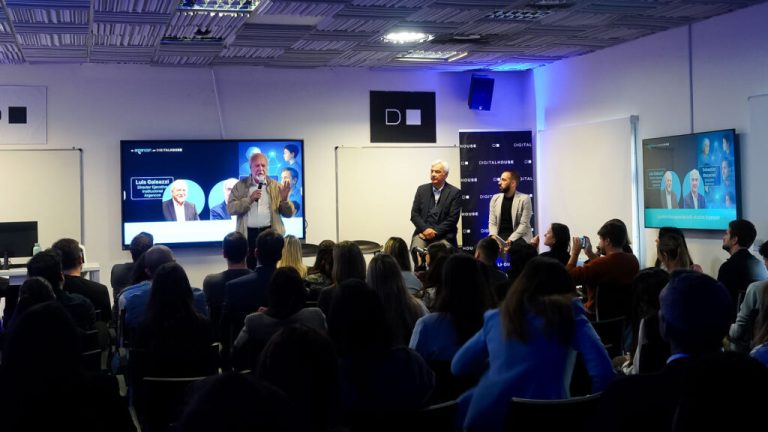
Martin Sorrell, founder and executive chairman of S4 Capital—a digital advertising and marketing services company—arrived in Argentina as part of an annual schedule of board meetings that also includes stops in Europe, North America, and Asia.
“This is our second-largest office in South America, after Brazil, where we have a significant operation in media, digital media planning and buying, and data,” he explained in an interview with LA NACION. “We have around 3,000 team members in the region, out of a global total of 7,000: approximately 850 in Buenos Aires, 400 in Mexico City, 400 in Colombia, and 1,400 in Brazil.”
He added, “People underestimate the strength, creativity, and technology in South America. The region has a young population, a high level of education, and very strong creative and technological capabilities. Argentina is a wonderful country.”
Sorrell held positions at companies such as Saatchi & Saatchi, James Gulliver, and Mark McCormack, but he reached the pinnacle of the industry with WPP, where he was founder and CEO of the holding company for 33 years. When he stepped down in 2018, the firm had a market capitalization of over £16 billion, revenues exceeding £15 billion, and employed more than 200,000 people across 113 countries.

In 2018, he established S4Capital, which quickly merged with MediaMonks, one of the leading digital content production companies, and later with MightyHive, a provider of digital solutions for innovative brands and agencies. Since then, both MediaMonks and MightyHive have acquired more than 25 companies. By 2021, S4Capital launched its unified brand, merging MediaMonks and MightyHive into a single entity: Monks.
How do you envision the balance between human talent and automation?
—In areas such as creative visualization and copywriting, employment will likely decline, as productivity is expected to increase significantly. At the same time, tasks like media planning and buying will increasingly be managed by algorithms, replacing manual or semi-automated processes, which will also lead to a reduction in jobs. However, in fields such as large-scale personalization—for example, targeted advertising on platforms like Netflix, Disney+, or Amazon Prime—we see a major growth opportunity that could generate more specialized employment.
How significant is the cost reduction?
—Recently, we produced a 30-second television commercial: it took 12 days to produce and required an investment of $200,000. Traditionally, a TV commercial would cost between $3 million and $4 million and take two months to complete. Another example: broadcasting a football match used to require a production truck that cost $10 million over five years—about $2 million per year. Meanwhile, we could now handle the broadcast using AI and cloud-based systems for $100,000 to $200,000, representing a 90% cost reduction—an enormous saving.
Is the industry prepared for this transformation?
Many people in our sector tend to downplay the change: they often claim that these technologies will merely be tools that will make us more efficient. And to some extent, they are correct. However, what is truly fascinating — and also concerning — will occur when machines begin to outperform humans in terms of efficiency. Looking ahead, I am not entirely convinced that the impact will be entirely positive. There will be benefits, but it will also be a process that is very difficult to manage. Machines will advance rapidly. Eric Schmidt, former CEO of Google, for instance, raises a highly relevant point: on platforms like TikTok, we can already see signs of how, in the next three or four years, machines will develop new capabilities. Some even believe that machines are already in a position to surpass certain human abilities. That’s why I believe control must lie in the hands of governments, who will need to act responsibly. Let us recall the case of Geoffrey Hinton, one of the pioneers of artificial intelligence and co-founder of DeepMind — a company acquired by Google in 2014 — who resigned from his position precisely because of his concerns about the potential risks of this technology. He raised several challenges: the potential replacement of traditional search engines, the issue of “hallucinations” — when AI provides incorrect answers — and the existential threat — the possibility that machines could become more powerful than humans.
What lies behind the resistance in the industry?
A McKinsey analysis shows that marketing is one of the areas most rapidly transformed by AI. However, the resistance does not stem from the technology itself, but rather from the natural fear of change. A good example is presented by Deborah Kant, an Argentine professional working at J.P. Morgan who leads a team dedicated to studying the future, not only with regard to AI but also to other exponential changes. She argues that current changes are occurring so rapidly that what one generation experienced over 20 years, our grandchildren will experience in just one. And she is correct: artificial intelligence generates anxiety due to the potential replacement of jobs, but there are other innovations that could radically transform our way of life and extend our life expectancy.
How does S4 Capital position itself in this scenario?
As a relatively small company, with 7,000 employees — around 3,000 of whom are based in Latin America — we have an advantage: we are more agile. We are strongly committed to technology, with a clear focus: we are digital-only. Currently, 70% of global advertising investment — out of a total of US$1 trillion — is allocated to digital media, and this segment is growing by 10% to 15% annually. In contrast, traditional media is in decline, with decreases ranging from 0% to 15% year-over-year, depending on the type of medium. In this context, our exclusively digital offering — supported by AI — enables us to reach audiences more quickly, at a lower cost, and at a greater scale. Additionally, we operate under a single brand, which simplifies and enhances our positioning.
What changes do you identify among your clients?
Our main clients are technology companies like Google, Apple, and Meta, which together represent nearly half of our revenues. These companies today invest more in capital expenditures (CapEx) related to artificial intelligence than in operating expenses (OPEX), which is precisely where we intervene. The so-called “Seven Magnificent” — Apple, Microsoft, Alphabet (Google), Amazon, Nvidia, Meta, and Tesla — together allocate around US$500 billion annually to CapEx. For instance, Google alone allocates US$75 billion per year to CapEx, compared to US$4.5 billion in marketing. This signals a profound shift: priorities are moving from OPEX — our traditional domain — to CapEx, creating a much more complex and challenging environment. Nevertheless, I remain optimistic. The key lies in applying technology intelligently across our industries: from creative visualization and copywriting, to large-scale personalization, media planning and buying, operational efficiency, and, above all, the democratization of knowledge. This is the path forward.
What role does the Buenos Aires office play in your strategy?
The Buenos Aires office serves two key functions. The first is to work with South American clients, including many Argentine companies like Mercado Libre, as well as global companies with a strong regional presence, such as Netflix and Google. Our focus in this area is on content, data, digital media, and digital transformation. The second function is related to the local economic structure, which allows us to operate from Argentina with remarkable cost efficiency, particularly for projects implemented in North and South America. This serves as a strategic hub for production and global services.
How do you evaluate the talent in the region?
It is sometimes underestimated, but South American talent — particularly Argentine talent — is exceptional, especially in creativity. Argentina has always excelled in the media world, and this talent has naturally transferred to the digital environment. Technologically, the region is also very strong. A good example is Globant, which, although it originated in Argentina, now has a regional presence. Buenos Aires is a key source of young, well-trained talent with excellent technical and creative capabilities. And, honestly, I believe much of the world still does not realize the value that exists here. Perhaps it’s best if it remains a secret. If we know it and no one else does, all the better.
In recent years, S4 Capital has acquired firms like MediaMonks and MightyHive. Do you consider that this process is complete, or are there new moves on the horizon?
Opportunities may arise in the future, but for now, our focus is on consolidation. We have revenues close to US$1 billion, but our margins are still not strong enough. We need to improve internal efficiency, and that is our main goal. We have very solid relationships with key clients — such as General Motors, BMW, Disney, and T-Mobile — and we must continue strengthening them. For the size of our company, we have deeper ties than average. We have the right structure for what we want to achieve. The primary focus must be on artificial intelligence and its implications for our industry.
Optimism regarding Argentina
How do you view the government of Javier Milei?
I’ll get straight to the point: I hope that with Milei, the economic situation improves significantly. I am very optimistic. I speak from an outsider’s perspective, but I believe Milei has made a significant difference. I regularly visit the cities in the region where we have offices, and I see a change in attitude. At the end of 2023, 25% of the people I spoke to supported what Milei was trying to do, while by last Christmas, 75% held that view. I believe he has made progress and surprised people. One economist told us: “If we had plotted a graph of what would happen to the Argentine peso as a result of the measures implemented, a much larger devaluation would have been predicted, yet instead, it remained relatively stable.” I believe Argentina is on the right track. One of our former clients, who is now retired, told me that he was studying Argentine history and that the country’s deficit issue dates back to 1822. Argentina was once the sixth richest country by GDP. I’m not suggesting it will return to that status, but I believe that, with its natural and human resources, it is in a very good position in a world where growth will be harder to achieve, and where inflation and interest rates will be higher.
How does the political and economic context influence business decisions?
We are in an era of political conflicts, such as those between the United States and China, Russia and Ukraine, or Russia and Iran. It is a very fragmented world, where growth will be harder to achieve, and companies will focus much more on where they should be. Instead of globalizing, they will concentrate on North and South America, the Middle East, and Asia, where the countries with the greatest potential are located. If the world grows at 3%, the United States might be slightly below that, while South America, the Middle East, and some regions of Asia may exceed that, and Europe will struggle. Therefore, first, companies must choose the right geographies, and second, they need technology that enhances efficiency. Artificial intelligence (AI), quantum physics, the metaverse, and blockchain are gaining significant importance in this broader context. If growth is around 5%, Argentina will attract a lot of foreign direct investment.
How do you view the global business climate today and in the future?
It is very uncertain. I do not believe this is a golden era, as former U.S. President Donald Trump suggested. I do not think the measures he implemented regarding tariffs on foreign trade will improve the situation, because they are merely a tax. On the contrary, they have generated significant uncertainty, which could extend beyond the 90-day moratorium he established for their application, or even last longer. In times like these, in companies where there is a separation between ownership and control — that is, between institutions and executives — management tends to be very conservative. CEOs typically stay in their role for an average of five years, while marketing directors stay for two and a half years. Therefore, there is a natural tendency not to create uncertainty and volatility: they avoid making decisions, delay them, or cancel them altogether. Once the uncertainty reduces, technological change will become paramount. Economic pressure will increase, and companies will face pressure to improve productivity, competitiveness, and efficiency. It will be a challenging period, but for the advertising and marketing sectors, given their focus on digital transformation, there will be a great opportunity. And AI will change the game.
Do you have any unfinished business in your career?
At the moment, I am fully focused on S4 Capital and Monks. We have a unique, purely digital brand, based on data, with a clear proposition: to be better, faster, and more cost-efficient. This is the model I want to consolidate and prove as the best for the industry. The real challenge for traditional agencies is adapting to this new reality, as we did with the development of that 30-second ad for US$200,000. AI-based techniques undermine the traditional model, and I believe we have a great opportunity. If there is one thing I would like to prove, it is that this model works.
Source: La Nación